Route description
No.7 – Aureole House
This was the site of the Golden Ball pub which was established in the 17th century. Its landlord for many years was Harry Wing, who ran a knackers yard at the rear. It closed in 1985, became a doctor’s surgery and is now offices. At the end of the street is St Mary’s Way
St Mary’s Way
This section of Church Street has been cut-off from the rest by the building of the dual carriageway. There used to be many old buildings and pubs all of which have been lost.
Turn left, then right to take the pedestrian crossing over St Mary’s Way. Turn right along the pavement and then left to continue along Church Street.
Archena Gardens
Located to the right of the Temperance Hall and dedicated to Chesham’s Spanish twin town, Archena. The gardens are maintained by the Friends of Lowndes Park.
Temperance Hall
In the mid- 19th century there were concerns about the effects of alcohol on the population and the temperance movement was born. The right-hand side of the hall was originally a separate cottage and once housed the town’s first police station. It is now home to The Little Theatre, managed by The Elgiva.
Ebenezer Cottages
These are a short distance past the hall, were built in 1834. In their courtyard once stood the Bidwell where worshippers heading to the church could wash themselves before worship.
The Sun House
Opposite the cottages was once the site of The Sun, a hostelry dating back to 15th century. It accommodated pilgrims and visiting monks. It was demolished in 1936 and re-erected as a private house on outskirts of town.
Cross into Bury Lane and walk along it into Lowndes Park.
Bury Lane
Previously Hearns Yard, was the scene of a typhoid outbreak in 1871 when 29 people, including the Reverend Aylward, died. At the top of the lane are Sixpenny Cottages, built for Lowndes Estate workers, the rent being sixpence per week
Lowndes Park
The first record of the land relates to its ownership by the Sifrewasts in the 12th century. It was later bought by the Skottowe family who owned Bury Hill House, which once stood where the Guide Hut is now located.
William Lowndes, Secretary to the Treasury, who came to Chesham in 1687, bought the land, demolished Bury Hill House and added the land to the grounds of his mansion, The Bury (Grade II listed). In 1953 the Lowndes family gave the park to the town. The first English National cross country race was run in 1914, finishing in the park. The town donated the silver trophy, The Chesham Challenge Cup. This race and its trophy continues each year around the country. Continue up the lane to the heavy metal gate on the left.
Rue de Houilles
On the right is the main avenue through the park. Once this was a carriageway flanked by a row of elms, first planted in c.1760. The elms were felled and replanted in 1845 by William Lowndes. These elms were felled in the 1950s, for fear of Dutch elm disease. Most trees, however, were found to be healthy after they were felled. The avenue is now more informal, planted with a mixture of species, including blossom trees. The avenue is also a bridleway and forms part of a national cycle route. It is named after our French twin town, Houilles.
Turn left through the gate and walk along to the main church entrance. Turn right through the entrance and walk up the path. On the right is the memorial to Thomas Harding.
St Mary’s Church
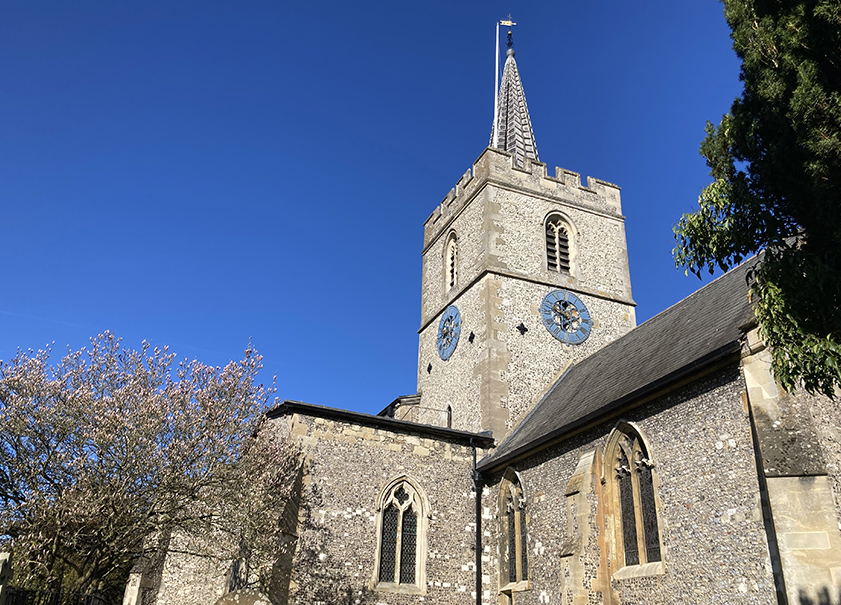
The stone and flint church was built on the site of a Bronze Age stone circle of puddingstone which has been incorporated into the base of the church. It is thought that a wooden church stood here in Saxon times. The current church dates back to the 12th century with later 14th and 15th century additions.
Over the years it has been remodelled a number of times including George Gilbert Scott in the 1860s. It is Grade I listed. Look out for the churchyard memorial to Thomas Harding, Chesham’s martyr, who was burnt at the stake in 1532 for reading the Bible in English (as covered in No 14 History Walk Thomas Harding). Turn left down the cobbled lane
The impressive building on the left is the 1720 Rectory. On the right are the Church Rooms built in 1845 as a National School. These schools provided elementary education for the poor in accordance with the teaching of the Church of England. The building on the left at the bottom at number 57 was the Star and Garter pub, Chesham’s last spit and sawdust pub. Its opening hours at one time were 5am to 10pm. It closed in 1936. Turn right into Church Street.
No. 50, Church Street
This was once the local conservative club, but is now private accommodation. During rebuilding evidence of a medieval hall house was found. No. 54 is thought to be oldest house in Chesham. This part of Church Street is called The Nap from an old English word “knap” meaning a rise in the ground.
Nos. 65 to 71, Church Street
These were estate houses belonging to the Lowndes family in The Bury.
The Bury
Once the home of seven generations of the Lowndes family. It was bought by William Lowndes, Secretary to Treasury to Queen Anne, in the late 17th century. It was midway between the Houses of Parliament and his estate in Winslow. It is now offices but has also been the home to Chesham’s own music festival – Buryfields. The high kerb stone along a section of the pavement was installed to help prevent flooding.
Nos 80 to 82, Church Street
Until 1900 this was Sarah How’s Brewery which made use of the clear, iron bearing spring water for ale making.
No. 109
Located on the corner of Pednor Road, this house used to be The Bell pub and dates from 1695. It is thought to have been the Tollhouse for the Chesham to Great Missenden turnpike. Have a look at the engraving on the glass window.
No. 120 Queens Head
One of Chesham’s favourite pubs which was first licenced in 1746.
Turn left into Wey Lane and, immediately after the pub, left again over the small footbridge.
Bury Brook
This is one of the main tributaries to the River Chess in the town Wrights Sawmill. On open ground on the left once stood Wrights Mill, a woodware factory, making hoops, bowls, bats, shovels, etc. There is an information board on site.
Horses used to drag tree trunks up the brook to feed the mill. Chesham was first known as ‘Caesteleshamm’ which roughly translates as a ‘water meadow by a pile of stones’ and it is thought that this was the water meadow referred to. The stones were probably puddingstones; this is the local stone conglomerate which looks like concrete with embedded pebbles. There is an example at the end of the wall to your right.
Continue down the footpath to Germain Street and turn right.
No. 35 Weylands
This was Chesham’s second workhouse and later became a private grammar school. In 1832 this workhouse was the scene of a riot when inmates refused to be transferred to the new Amersham Union Workhouse in Old Amersham.
New Footpath
Chesham’s first workhouse was The Old Poor House built 1540 and housed some 20 or so inmates. The able-bodied were put to work in the workhouse gardens. A small portion still remain as allotments on the corner of Germain Street and Wey Lane. By the early 1700s the number of paupers had increased and they were moved to Weylands. Turn around and walk back down Germain Street.
No. 32 The Meades
This fine 18 th Century building was once home of Mr Meades, owner of one of Chesham’s two tanneries. Town Bridge was originally known as Townfield Bridge. On the brick wall by the river can still be seen a faded painted sign “Pump Site” which probably dates from WWII where firemen could draw water.
Nos. 16 to 18
From 1899 until 2009 these were the offices of the local newspaper, The Buckinghamshire Examiner. In 1960 it became the first weekly in the country to carry a full-colour page advertisement, and full-colour news photograph.
New houses opposite
This was the site of the Art Deco Embassy cinema which opened on 11 January 1935. It had air-conditioning and seated over 1,000 people. Like many cinemas it couldn’t compete with the success of television and closed in 1982. It was demolished a year later. In 1940 four bombs fell on Germain Street killing one person, destroying a local forge and damaging the front of The Embassy. Walk back a few metres and turn left down Duck Alley which runs parallel to the river.
Duck Alley
A row of workers cottages once stood here, demolished in slum clearance of the 1930s. In the 19th century its occupants would have been some of Chesham’s many lace makers and home bootmakers, and they would have kept ducks on river for their own consumption. Walk through Meades Water Gardens to Amersham Road at the end.
Meades Water Gardens
Originally the location of the millstream for Amy Mill, of which only the sluice gate now remains. The site was converted for use as watercress beds, and later, ornamental gardens. In 2008 the river was restored as part of a project to regenerate the gardens. Over the past few years the river has sometimes run dry through the town, the main causes being low rainfall and abstraction from the underlying aquifer for public water supply.
Turn right to see the artwork in the brick wall.
Amersham Road, Friedrichsdorf Corner
is named after one of Chesham’s twin towns but is also the site of the old Amy Mill. Possibly one of the four Chesham mills mentioned in Domesday Book. Owned in 19th century by the Rose family, who opened a new steam mill across the road in 1845. Cross over Amy Lane and walk up Amersham Road.
Chesham Bois Manor
Built in 1880 for the Garret-Pegge family who called it Chesham House. The name changed when they purchased the Lordship of the Manor from the Duke of Bedford. Somewhere behind the wooden fencing towards the roundabout lies the entrance to Old Beech Lane which was formerly the route between Chesham and Amersham.
Walk back, cross over Amy Lane and continue into Chesham. On the opposite side of the road is Mineral Cottage.
Mineral Cottage
In 1820 an iron- bearing spring was discovered and a group of local businessmen decided to exploit it as a spa. It opened in 1821 but unfortunately ran dry a few years later.
Follow the pavement into Red Lion Street.
The Courtyard
This used to be the site The Nag’s Head Inn and meadow. The pub dated from 1695 but was demolished for road widening in 1937. For many years the meadow was used as a sheep and cattle market and later a roller skating rink. Silent films were also shown.
The Forelands
A late 17th century Grade II listed house on the right of Punchbowl Lane. The land used to be used for medieval strip farming and ‘Forelands’ means a ploughing turning area at the end of a field.
Trinity Baptist Church
The Punch Bowl pub used to stand on this site but was later demolished to make way for the Hinton Baptist Chapel. When the church combined with the Zion Chapel further down the road, it changed its name to Trinity.
The Red Lion
The original pub dated back to 1723. For many years it was used as a coroner’s court with dead bodies placed in the stables behind. The pub, however, was on a very tight bend and was demolished in 1937 along with The Nags Head Inn. It was replaced by the current building.
Take the pedestrian crossing by the Red Lion and turn right. Cross over East Street, turn left and immediately right into Townfield.
Townfield
This used to be a medieval common field, divided into strips and stretching from the Town Bridge and up the hill to Dungrove Farm. It became a narrow street that led to a Baptist church and The White Lion pub. It was notorious as being a rough area and much of it was demolished in 1935 under a slum clearance order. No. 18A was the site of the British School, Chesham’s first free school founded in 1828 with 150 pupils.
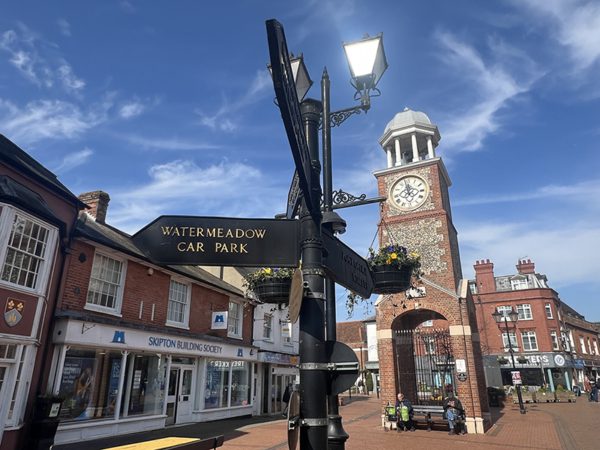
Head back towards the pedestrian crossing and continue ahead into the Market Square to finish the walk.
Edited for web by Amanda Carroll with permission.
Original printed leaflet published by Hawkes Design & Publishing.